


The mathematics of survival along the Nigeria-Cameroon border have always been brutal. In the three years following the 2020 closure of key crossing points, customs revenues at Amchidé-Banki collapsed by nearly 70%, strangling an economy already hemorrhaging from a decade of insurgent violence. When authorities finally reopened these arteries in 2023, the immediate economic revival seemed to validate what local traders had insisted all along: you cannot starve extremism out of a region by first starving its people.
Yet within months of the reopening, something darker emerged from the data. Institute for Security Studies researchers documented a sharp uptick in ambushes along the newly bustling trade routes—convoy attacks, targeted kidnappings of livestock traders, systematic extortion at unofficial "checkpoints" operated by men carrying weapons more sophisticated than those wielded by many state forces. The very commerce meant to stabilize the Lake Chad Basin was becoming the logistical backbone of Boko Haram's resurgence. This is not a paradox. It is the predictable outcome when economic policy outpaces security architecture in one of Africa's most complex conflict zones.
The uncomfortable question hanging over the border reopening is whether the international community, distracted by conflicts elsewhere and increasingly fatigued by the Sahel's seemingly intractable crises, has learned anything at all from fifteen years of failed interventions. Or are we watching, once again, the familiar pattern of short-term economic fixes applied to structural problems whose roots run far deeper than any quarterly customs report can measure?
The revival that armed the enemy
Cameroon's customs stations at Amchidé and Fotokol recorded something approaching euphoria in their first post-reopening fiscal reports. Monthly revenues jumped from negligible amounts to figures approaching pre-2020 levels, driven primarily by cross-border livestock trade and food commodity movements. For communities that had watched their livelihoods dissolve during the closure years, the return of commercial activity meant more than economic statistics—it represented the possibility of normalcy, however fragile.
Local administrators celebrated the return of displaced populations, particularly to border towns like Fotokol, where market days once again drew crowds. Road infrastructure improvements, funded partly through regional cooperation frameworks, made movement faster and theoretically safer. The Regional Stabilisation Strategy championed by the Lake Chad Basin Commission member states pointed to these developments as evidence that coordinated economic recovery could succeed where purely military approaches had failed.
What these reports consistently underplayed was the intelligence emerging from the same transportation corridors. ISWAP—the Islamic State West Africa Province faction that had eclipsed Abubakar Shekau's Jama'atu Ahlis Sunna Lidda'awati wal-Jihad (JAS) following his 2021 death—had not been idle during the border closure. The group had refined its economic model, moving beyond simple banditry toward sophisticated taxation systems in territories under its control. The border reopening didn't just restart legitimate commerce; it mainlined resources directly into insurgent supply chains.
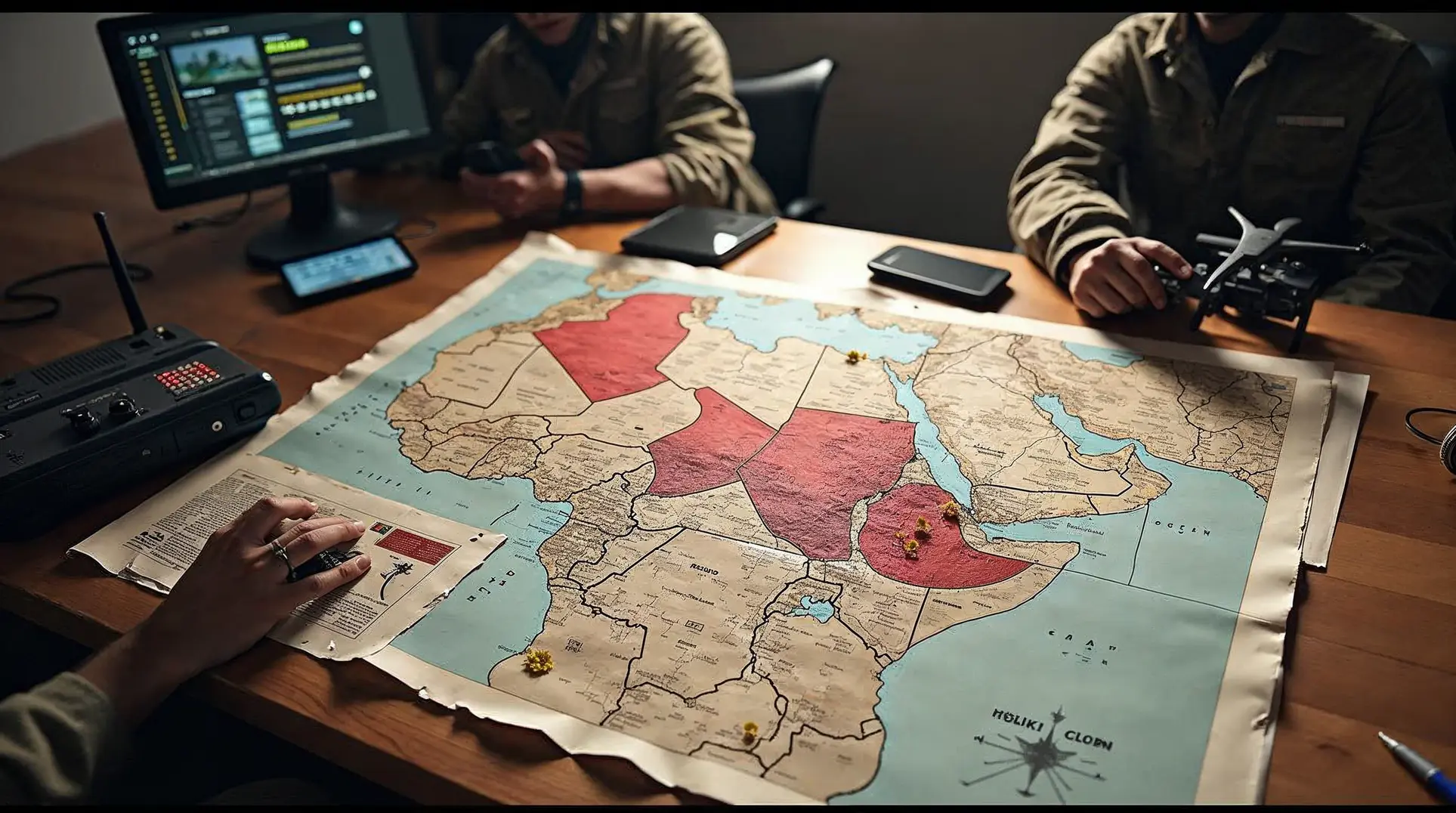
🔓 UNLOCK: Discover how ISWAP weaponized your smartphone and solar panels—the shocking infrastructure double-game funding their armed drone fleet while governments celebrate 'development'.
The Multinational Joint Task Force, comprising troops from Nigeria, Cameroon, Chad, and Niger, has conducted numerous operations aimed at disrupting insurgent networks. Yet the historical "mutual suspicion" between Nigerian and Cameroonian security establishments—rooted in decades of border disputes and competing sovereignty claims—has repeatedly undermined intelligence sharing at critical moments. Insurgent commanders understand these fault lines intimately and exploit them with precision, moving fighters and materiel across boundaries when coordination lapses create temporary sanctuaries.
The humanitarian mathematics of insurgency
Behind every customs revenue statistic celebrating the border reopening lies a more disturbing calculus: the millions displaced, the systematic targeting of aid workers, the collapse of social structures in communities that have experienced violence for fifteen consecutive years. The humanitarian crisis in the Lake Chad Basin doesn't merely coexist with the security situation; it feeds it in ways that make neat policy distinctions between "humanitarian intervention" and "counter-insurgency" increasingly meaningless.
Displacement patterns around Fotokol and Amchidé illustrate this interconnection. Families who returned when borders reopened found themselves caught between economic necessity—the need to participate in reviving trade networks—and security imperatives that made any movement potentially lethal. Convoy attacks don't distinguish between purely commercial transporters and those carrying humanitarian supplies. The result is a population living in constant calculation of acceptable risk, a form of psychological warfare that extends insurgent influence far beyond territories they physically control.
Food insecurity in the region has reached levels that challenge conventional humanitarian response models. When aid organizations cannot access populations due to insurgent interference, and when trade routes that might alleviate shortages are compromised by the same groups, the traditional tools of crisis management become inadequate. Malnutrition rates among children in some border communities mirror those seen in active famine zones, yet this is happening in a region where food production is theoretically possible—if security allowed it.
The gendered dimensions of this crisis deserve particular attention, as they're often buried in aggregate statistics. While child marriage rates among displaced girls show context-specific increases—with some studies documenting up to 30% higher risk compared to host communities—the pattern is not universal across all displacement settings. What is consistent, however, is the brutal reality that displaced girls face heightened vulnerability driven by economic hardship and families' desperate attempts at protection. Armed groups, including insurgent forces, have been documented systematically targeting adolescent girls for forced marriage and recruitment, constituting grave violations that weaponize displacement itself. The variability in child marriage trends across different displaced populations underscores how local contexts shape vulnerability, but this should not obscure the fundamental truth: displacement creates protection crises that insurgents deliberately exploit. Women and girls become literally contested terrain in these power struggles.

⚠️ MEMBERS ONLY: Why Lake Chad's 90% disappearance is actually a debt crisis in disguise—and how IMF policies from the 1980s armed today's insurgents with droughts, floods, and desperate recruits.
The targeting of humanitarian workers represents a particularly cynical dimension of insurgent strategy. By making aid delivery life-threatening, groups like ISWAP ensure that state failure becomes visible and sustained, reinforcing narratives about governmental inability to protect citizens or provide basic services. Each aid convoy that turns back due to security concerns is a small victory for those who benefit from ungoverned spaces.
The illusion of purely military solutions
Nigerian and Cameroonian security forces have conducted countless operations against Boko Haram and its offshoots over the past fifteen years. Some have achieved tactical successes—clearing territories, killing commanders, disrupting supply lines. Yet the insurgency persists and, in some respects, has become more sophisticated. This isn't because military action is inherently useless; it's because military action deployed without corresponding governance, economic, and social interventions addresses symptoms rather than causes.
The attacks on military bases at Dikwa, Mafa, Gajibo, and Katarko demonstrate that insurgent groups possess both the capability and confidence to engage state forces directly, rather than limiting themselves to asymmetric harassment. These weren't opportunistic raids; they were coordinated operations suggesting intelligence about defensive weaknesses and the capacity to concentrate forces despite counter-insurgency pressure.
State security forces' own human rights record complicates the narrative of protection versus threat. Documented cases of extrajudicial killings, arbitrary detention, and collective punishment of communities suspected of harboring insurgents create grievances that feed recruitment. When populations cannot trust state forces to distinguish between civilians and combatants, the social foundation for effective counter-insurgency collapses. Communities begin calculating whether cooperation with military operations might bring more danger than tolerance of insurgent presence—a calculus that undermines the entire security project.
The deadly return of suicide bombings signals tactical evolution that should concern regional security establishments. This represents a capability that requires not just ideological commitment but technical knowledge, explosive materials, and the kind of organizational discipline to plan and execute such attacks. The resurgence of this tactic suggests either reconstitution of networks previously degraded or successful knowledge transfer between insurgent factions.
Meanwhile, instability ripples outward in ways that transcend the immediate conflict zone. Sudan's war spilling into the Central African Republic illustrates how ungoverned border regions in one crisis create vulnerabilities in adjacent states. The Lake Chad Basin's persistent insecurity similarly exports instability, with displaced populations, arms flows, and extremist networks affecting territories far from the core conflict areas. This regional interconnection means that failure to stabilize Nigeria-Cameroon borders has implications for the entire Sahel security architecture.
Even political instability in Cameroon itself, where opposition leaders contest electoral outcomes and governance legitimacy remains contested, undermines the state capacity necessary for sustained counter-insurgency. An internally divided government cannot project the kind of unified, legitimate authority that effective border management requires. Insurgent groups understand and exploit these political fractures, positioning themselves as alternative power structures in areas where state legitimacy is already questionable.
Rethinking intervention in an age of global distraction
The original framing of this analysis—centered on US sanctions against Russian oil giants in the context of Ukraine—may seem distant from the realities of the Lake Chad Basin. Yet the connection is more direct than geographic separation suggests. International attention, diplomatic bandwidth, and financial resources are finite. When major powers focus overwhelmingly on great power competition and European security, the inevitable consequence is reduced engagement with African conflicts that lack obvious strategic value to external actors.
This isn't merely about resource allocation; it's about the epistemological frameworks through which conflicts are understood and addressed. The tendency to view African instability through the lens of counter-terrorism or humanitarian crisis, rather than as complex political-economic-environmental systems requiring comprehensive engagement, reflects persistent colonial patterns of analysis. The Lake Chad Basin crisis is treated as a problem to be managed rather than a structural challenge requiring transformation of the relationships between state, society, and economy.
The border reopening between Nigeria and Cameroon represents a small-scale example of this larger pattern. It was undertaken with genuine good intentions and has produced real economic benefits. But it occurred within a strategic vacuum—without corresponding investments in security architecture, governance capacity, or the structural economic reforms that might make prosperity sustainable rather than exploitable. The result is a dangerous bargain in which economic revival and insurgent resurgence feed off each other in a vicious cycle.
What African states need isn't more technical assistance or another externally-designed strategy document. What's required is sustained, patient engagement that centers African agency and acknowledges that solutions will emerge from within the region, not be imported from outside. This means supporting the Lake Chad Basin Commission and regional institutions with resources and political backing, rather than bypassing them with bilateral interventions. It means addressing the debt burdens and extractive economic relationships that constrain state capacity. It means taking seriously the environmental dimensions of the crisis and supporting climate adaptation as security policy.
Most fundamentally, it requires international actors to acknowledge that their attention spans and funding cycles don't align with the timescales on which structural change occurs. A fifteen-year insurgency didn't emerge overnight, and it won't be resolved in a single electoral cycle or fiscal year. Communities in the Lake Chad Basin have survived by developing their own resilience mechanisms, their own conflict resolution practices, their own economic networks. External intervention should strengthen these existing capacities rather than replacing them with imported models that evaporate when donor interest fades.
The question isn't whether Nigeria and Cameroon can afford to keep their borders open. It's whether they can afford not to—and whether the international community will provide the sustained support necessary to make that opening genuinely stabilizing rather than an inadvertent gift to the insurgents who have devastated the region for far too long. The mathematics of survival in the Lake Chad Basin have always been brutal. Making them less so requires more than customs revenue and military operations. It requires a fundamental rethinking of how external actors engage with African conflicts in an era when their attention is persistently elsewhere.
Subscribe to our free newsletter to unlock direct links to all sources used in this article.
We believe you deserve to verify everything we write. That's why we meticulously document every source.


